
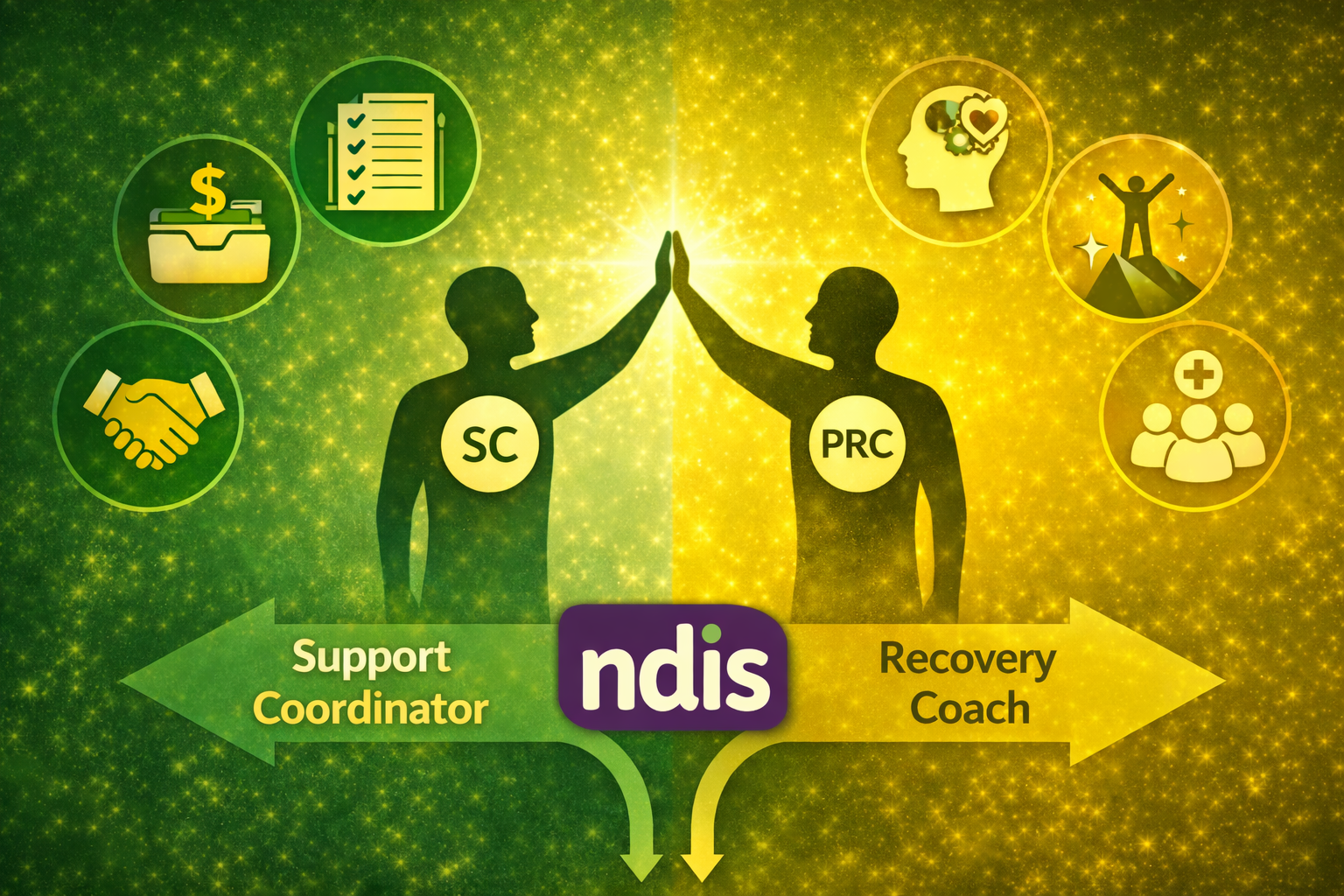
Navigating the National Disability Insurance Scheme (NDIS) can be complex, particularly when it comes to understanding the distinct roles of Support Coordinators (SC) and Psychosocial Recovery Coaches (PRC). While both roles are designed to support participants in meaningful ways, confusion around their responsibilities often leads to unmet expectations and underutilised funding.
This article explores the five most common misunderstandings participants have about SCs and PRCs, and clarifies how these roles can work together effectively to support a participant’s goals and recovery journey.
Understanding the roles
Before addressing the misunderstandings, it is important to briefly outline the purpose of each role.
A Support Coordinator helps participants understand and implement their NDIS plan. This includes connecting participants with appropriate service providers, building their capacity to manage supports independently, and ensuring services align with their goals.
A Psychosocial Recovery Coach, on the other hand, focuses specifically on supporting individuals with psychosocial disability. Their role is centred on recovery-oriented practice, helping participants build resilience, develop life skills, and work toward greater independence and wellbeing.
1. Expecting a Support Coordinator to provide mental health recovery
One of the most common misconceptions is that a Support Coordinator will directly support a participant’s mental health recovery.
In reality, Support Coordinators do not provide therapeutic or clinical support. Their role is to facilitate access to services, not to deliver mental health interventions. Participants who require recovery-focused support should engage a Psychosocial Recovery Coach or appropriate clinical professionals.
Misunderstanding this distinction can result in participants feeling unsupported, when in fact they may not be accessing the right type of service for their needs.
2. Assuming a PRC will manage finances and budgets
Another frequent misunderstanding is that a Psychosocial Recovery Coach will manage a participant’s NDIS funding, including budgeting and payments.
Financial management is not part of the PRC role. Instead, this responsibility typically sits with a plan manager or the participant themselves if they are self-managed. The PRC’s focus remains on recovery, capacity building, and supporting the participant to navigate daily challenges.
Expecting financial management from a PRC can lead to confusion and gaps in plan utilisation.
3. Believing only one role is needed
Some participants assume they must choose between a Support Coordinator and a Psychosocial Recovery Coach, believing the roles overlap significantly.
In practice, these roles are complementary. A Support Coordinator focuses on navigating the NDIS system and connecting supports, while a PRC works more closely with the participant on personal recovery and long-term independence.
When both roles are used together effectively, participants benefit from a balanced approach that addresses both practical coordination and personal development.
4. Expecting SCs and PRCs to do everything
It is not uncommon for participants to expect their providers to take full control of their supports, including making decisions, organising services, and resolving all issues.
However, the NDIS is fundamentally designed as a capacity-building framework. Both SCs and PRCs are there to guide, support, and empower participants not to replace their decision-making.
Participants who actively engage in their plan and build their own skills tend to achieve more sustainable and meaningful outcomes.
5. Not encouraging collaboration between SCs and PRCs
A less obvious but equally important misunderstanding is the assumption that SCs and PRCs can operate independently without coordination.
In reality, collaboration between these roles is essential. When Support Coordinators and Recovery Coaches communicate and align their efforts, participants experience more consistent support, clearer goal progression, and better use of funding.
A lack of communication between providers can lead to duplication of services, confusion, and inefficiencies in plan implementation.
Why These Misunderstandings Matter
Misunderstanding the roles of SCs and PRCs can significantly impact a participant’s experience within the NDIS. It can result in frustration, unmet expectations, and inefficient use of funding.
Conversely, a clear understanding of each role allows participants to engage the right supports, set realistic expectations, and make informed decisions about their care.
Making the most of your NDIS supports
To maximise the benefits of both Support Coordination and Psychosocial Recovery Coaching, participants should:
- Clearly understand the purpose of each role
- Engage both roles where appropriate
- Maintain open communication with providers
- Stay actively involved in their own plan and decision-making
By doing so, participants can create a more structured, supportive, and effective pathway toward achieving their goals.
Conclusion
The NDIS provides a powerful framework for support, but its effectiveness depends on how well participants understand and use the services available to them. Support Coordinators and Psychosocial Recovery Coaches each play distinct and valuable roles, and when used together, they can significantly enhance a participant’s journey toward independence and wellbeing.
Clarity, collaboration, and active participation are key to unlocking the full potential of an NDIS plan.
#NDIS #NDISAustralia #NDISSupport #NDISParticipants #NDISProvider #NDISCommunity #DisabilitySupportAustralia #SupportCoordination #PsychosocialRecoveryCoach #RecoveryCoach #NDISSupportCoordinator #MentalHealthSupportAustralia #NDISMentalHealth #DisabilityServices #NDISAwareness #NDISTips #NDISEducation #NDISJourney #NDISLife #SupportServices #Empowerment #AdelaideBusiness #AdelaideNDIS #SouthAustraliaNDIS #AdelaideSupportServices #Liightmeupagain #Liightmeupagainservices #Socialwork #NDISSupportcoordination#NDISPsychosocialrecoverycoaching #Thrivewithzakia #Personaldevelopmentcoaching #Mindsetcoaching #Publicspeaking #Resileincespeaker #Recoveryspeaker #Careerdevelopmentcoaching #Professionaldevelopmentcoaching #Leadershipcoaching #Relationshipcoaching #Consultation #Emotionaleesilience #Self-guidedprogram #NDIS #NDISTips #NDISGuide #DisabilitySupport #NDISHelp #NDISFunding #NDISExplained #NDISCommunity #NDISServices #DisabilityAustralia #SupportCoordination