

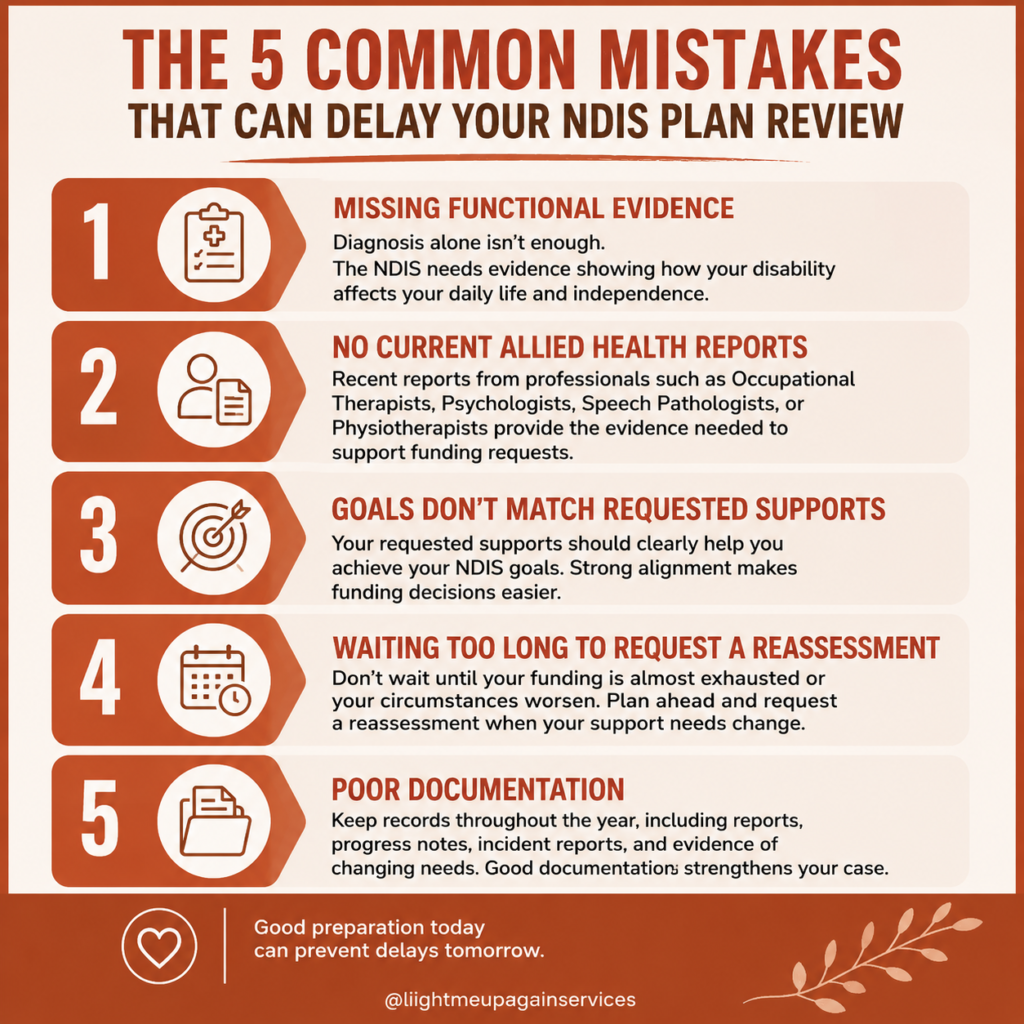
The National Disability Insurance Scheme (NDIS) is designed to provide participants with the supports they need to live more independently and achieve their goals. However, one of the most frustrating experiences for participants and their families is waiting longer than expected for a plan review or reassessment. In many cases, delays are not caused by the participant themselves but by missing information, insufficient evidence, or incomplete documentation.
As a Support Coordinator and Psychosocial Recovery Coach, I’ve seen how small oversights can significantly impact the outcome and timing of a plan review. Understanding these common pitfalls can help participants prepare a stronger case and reduce unnecessary delays.
Why do NDIS plan reviews get delayed?
An NDIS plan review is an opportunity to ensure your supports continue to meet your current needs. The NDIS relies on evidence to determine whether your existing funding remains appropriate or whether changes are required. The stronger and more relevant your evidence, the easier it is for the NDIS to make an informed decision. Let’s look at the five most common mistakes.
1. Missing functional evidence
What is functional evidence?
Functional evidence explains how your disability affects your everyday life rather than simply identifying your diagnosis. The NDIS funds supports based on the impact of your disability on daily functioning not the diagnosis alone.
Examples include difficulties with:
- Personal care
- Communication
- Mobility
- Managing emotions
- Household tasks
- Community participation
- Employment or education
- Building and maintaining relationships
Why is this important?
A medical diagnosis tells the NDIA what condition you have.
Functional evidence explains how that condition affects your daily life and why specific supports are reasonable and necessary.
How to avoid this mistake?
Before requesting a review, gather reports that clearly describe:
- Current functional limitations
- Changes since your last plan
- Risks if supports are reduced
- Progress made with existing supports
- Future support needs
2. Not having current allied health reports
What are allied health reports?
These reports are written by professionals such as:
- Occupational Therapists
- Physiotherapists
- Speech Pathologists
- Psychologists
- Exercise Physiologists
- Behaviour Support Practitioners
Why are they important?
These professionals assess your current functioning and recommend evidence-based supports.
Without recent reports, the NDIA may not have enough information to justify increasing funding or approving new supports.
Common problems
Many participants submit:
- Reports that are several years old
- Reports that no longer reflect their current situation
- Reports that don’t include recommendations
Best practice
Aim to obtain updated reports before requesting a reassessment, particularly if:
- Your condition has changed
- You need assistive technology
- You require additional therapy
- Your informal supports have reduced
- Your living circumstances have changed
3. Goals that don’t match the supports you’re requesting
One of the most common issues is requesting supports that don’t clearly connect to your NDIS goals.
For example:
Goal:
“I want to become more independent in my community.”
Requested support:
- Home modifications
- Increased personal care
- Support Coordination
Unless the relationship between these supports and your goal is explained, the NDIA may question why the funding is necessary.
Good goals are:
Specific
Meaningful
Achievable
Connected to your disability
Supported by evidence
Ask yourself:
How does this support help me achieve my goal?
If you cannot clearly answer that question, the NDIA may struggle to justify funding it.
4. Waiting too long to request a reassessment
Many participants wait until:
- Their funding has almost run out
- Their condition has significantly deteriorated
- Therapy has stopped
- Their support workers are no longer available
Unfortunately, waiting too long can create unnecessary stress and gaps in support.
When should you consider requesting a reassessment?
If: Your disability has changed, or You’ve had multiple hospital admissions, or You’ve experienced a mental health relapse, or Your informal supports are no longer available, or You need different supports, or You’ve moved house, or Your functional capacity has declined, or Early planning allows time to gather evidence before funding becomes critical.
5. Poor documentation
Documentation tells the story behind your support needs.
Examples include:
Progress notes
Incident reports
Hospital discharge summaries
Support worker observations
Therapy reports
Risk assessments
Emails showing changes in circumstances
Housing reports
Without documentation, it becomes much harder to demonstrate why additional funding is required.
Keep records throughout the year
Don’t wait until your review is due.
Maintain a folder containing:
Medical appointments
Assessment reports
Therapy summaries
Support Coordinator notes
Hospital documents
Any significant changes in your circumstances
Good documentation creates a clear timeline that supports your request.
How can a support coordinator or psychosocial recovery coach help?
A Support Coordinator or Psychosocial Recovery Coach can assist by:
✔ Identifying evidence gaps
✔ Coordinating reports from allied health professionals
✔ Helping you prepare for a plan reassessment
✔ Ensuring requested supports align with your goals
✔ Liaising with providers
✔ Documenting significant changes
✔ Supporting communication with the NDIA
The earlier this preparation begins, the smoother the review process is likely to be.
A successful NDIS plan review isn’t just about requesting more funding, it’s about presenting a clear, evidence-based picture of your current circumstances and future support needs. Preparation matters. By gathering strong functional evidence, keeping documentation up to date, ensuring your goals align with requested supports, and seeking reassessment when your circumstances change, you give yourself the best opportunity for a timely and well-informed decision. Every participant’s journey is unique, and every review should reflect their individual needs, aspirations, and lived experience.
Disclaimer: This article provides general information only and should not be considered legal or financial advice. NDIS policies, pricing arrangements, and operational guidelines may change over time. Participants should refer to current NDIS guidance or seek advice from a qualified professional regarding their individual circumstances.