

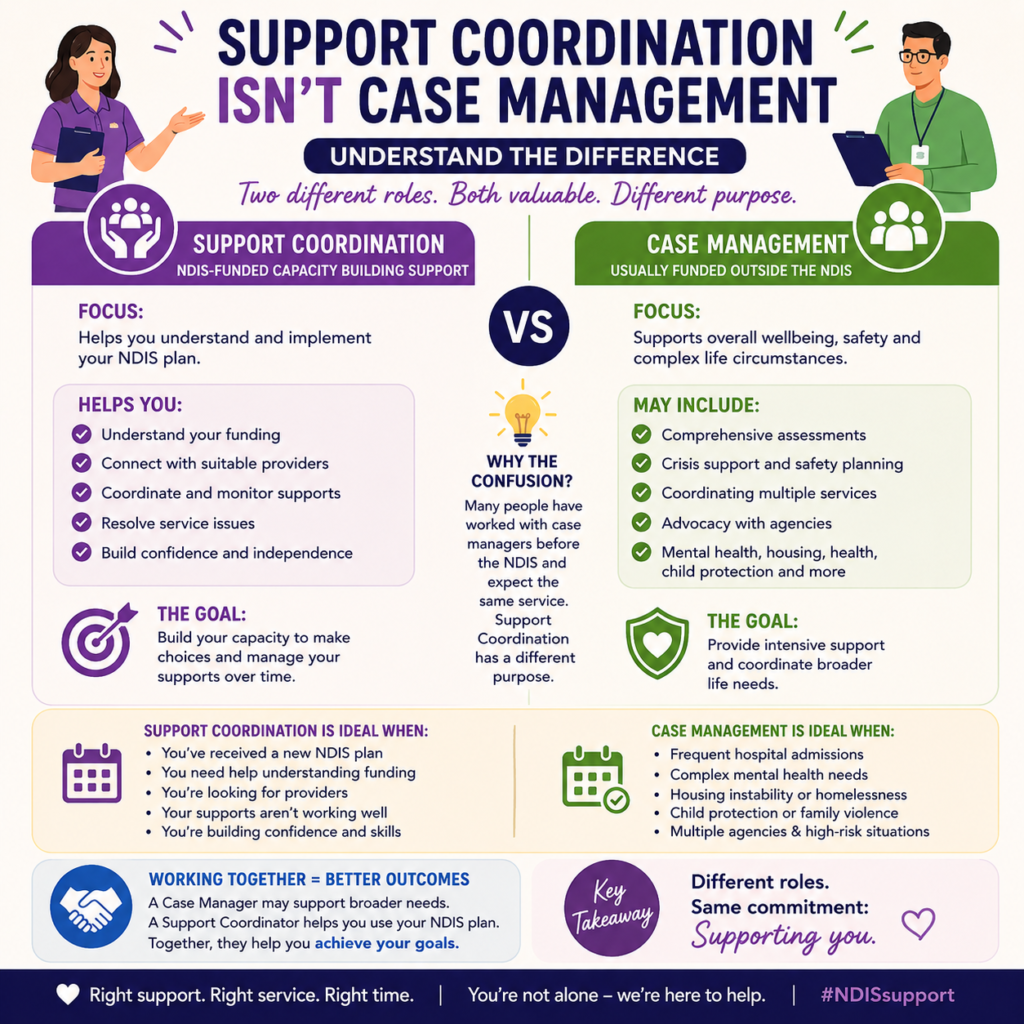
Many NDIS participants and families use the terms Support Coordination and Case Management interchangeably. While they share some similarities, they are not the same service. Understanding the difference can help you know what to expect from your Support Coordinator and when you may need additional services.
What Is Support Coordination?
Support Coordination is an NDIS-funded Capacity Building support that helps participants understand and implement their NDIS plan.
The focus is on building the participant’s capacity to:
- Understand their NDIS funding
- Connect with appropriate providers
- Coordinate supports
- Resolve service delivery issues
- Build confidence to manage supports over time
A Support Coordinator works with the participant, rather than doing everything for them.
The goal is to increase independence while helping participants make the most of their NDIS plan.
What Is Case Management?
Case Management is a broader service that is often provided by hospitals, mental health services, child protection, homelessness services, aged care, or community organisations.
A Case Manager may:
- Conduct comprehensive assessments
- Provide ongoing intensive support
- Coordinate multiple government and health services
- Manage crisis situations
- Advocate with different agencies
- Monitor safety and wellbeing
- Arrange interventions outside the NDIS
Case management is generally not funded through an NDIS Support Coordination budget.
Why do people get confused?
There are several reasons. Many participants have previously worked with a hospital social worker, mental health clinician, or community case manager before entering the NDIS. When they begin receiving Support Coordination, they naturally expect the same type of service. However, Support Coordination has a different purpose. It is designed to help participants use their NDIS funding effectively, not to replace broader case management or provide ongoing intensive management of every aspect of a person’s life.
When is support coordination appropriate?
Support Coordination is particularly valuable when:
- You have received a new NDIS plan.
- You need help understanding your funding.
- You are looking for suitable providers.
- Your circumstances have changed.
- Your current supports are not working well together.
- You are preparing for a plan reassessment.
- You need assistance navigating the NDIS system.
When might you need case management instead?
Case management may be more appropriate when someone is experiencing:
- Frequent hospital admissions
- Homelessness or housing instability
- Complex mental health crises
- Child protection involvement
- Family violence
- Significant safeguarding concerns
- Multiple government agencies involved in their care
In these situations, a Support Coordinator will often work alongside the relevant case manager rather than replacing them.
Where does a support coordinator add value?
A Support Coordinator helps participants translate their NDIS plan into practical supports by:
- Explaining NDIS funding categories
- Connecting participants with providers
- Coordinating services
- Monitoring whether supports are working
- Identifying barriers to accessing services
- Assisting with service agreements
- Supporting changes in circumstances
- Preparing for plan reassessments
- Building the participant’s confidence to make informed choices
Their role is centred on implementation and capacity building, not long-term case management.
How do the roles work together?
The best outcomes often occur when services work collaboratively.
For example:
- A Case Manager may support someone experiencing homelessness by coordinating emergency accommodation and health services.
- A Support Coordinator may then arrange NDIS-funded supports such as personal care, occupational therapy, psychosocial recovery coaching (where funded), or community participation services.
Each professional has a different role, but together they contribute to a coordinated support system.
A simple comparison
| Support Coordination | Case Management |
| NDIS-funded Capacity Building support | Usually funded by health, government, or community services |
| Focuses on implementing the NDIS plan | Focuses on broader life circumstances and complex needs |
| Builds the participant’s capacity | May provide intensive, ongoing management |
| Connects participants with NDIS providers | Coordinates multiple service systems |
| Supports NDIS goals | Supports overall wellbeing, safety, and crisis responses |
In conclusion, Support Coordination and Case Management both play valuable roles, but they serve different purposes. A Support Coordinator helps you understand your NDIS plan, connect with the right providers, and work towards your NDIS goals. A Case Manager provides broader coordination when a person’s needs extend beyond the NDIS. Knowing the difference helps set realistic expectations and ensures participants receive the right support from the right service at the right time.
#liightmeupagain #liightmeupagainservices #Socialwork #supportcoordination #psychosocialrecoverycoaching #thrivewithzakia #personaldevelopmentcoaching #mindsetcoaching #careerdevelopmentcoaching #publicspeaking #mentor #mentoringsupport #inhomesupport #communityengagement #ndisprovidersadelaide #leadershipcoaching #relationshipcoaching #resileincespeaker #recoveryspeaker #professionaldevelopmentcoaching #consultation #NDIS #NDISTips #NDISGuide #DisabilitySupport #NDISHelp #NDISFunding #NDISExplained #NDISCommunity #NDISServices #DisabilityAustralia