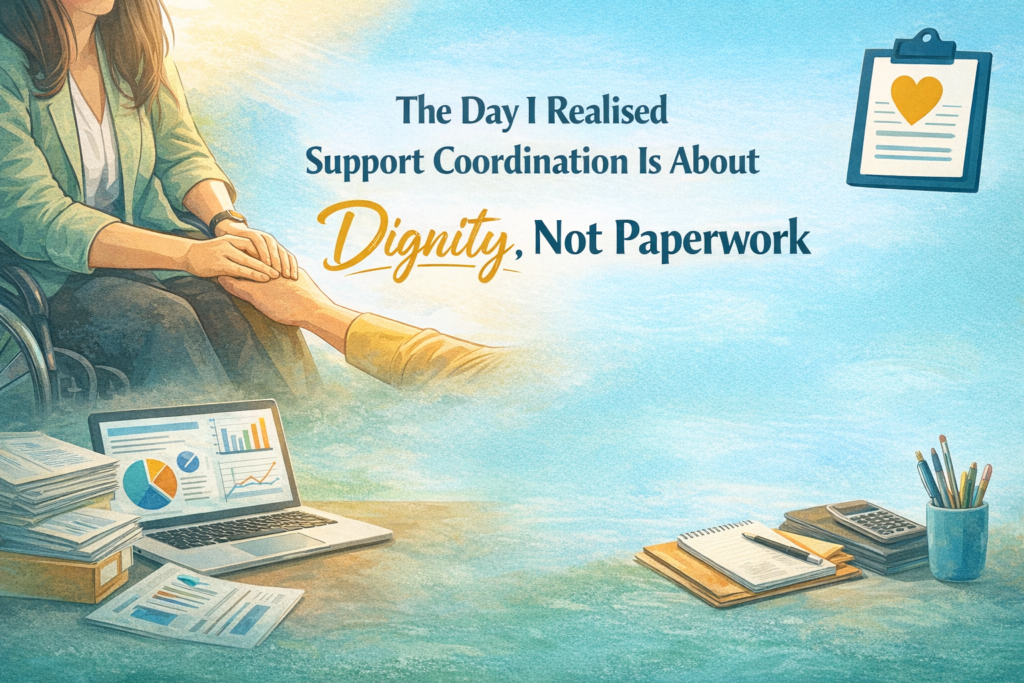
There was a day early in my work as a Support Coordinator when something shifted in me. Until then, I had been focused on the mechanics, such as budgets, categories, invoices, service agreements, plan reviews, Core funding, Capacity Building, reporting requirements. All of it important. All of it necessary. But on that particular day, I sat across from a participant who was exhausted. Not just tired, exhausted from repeating their story, exhausted from explaining their disability, exhausted from systems that required proof before offering support. In that moment, I realised something powerful: support coordination is not about paperwork. It is about dignity.
People living with disability or psychosocial challenges already carry enough. They carry appointments, assessments, stigma, and uncertainty. The NDIS is designed to provide support, yet navigating it can feel overwhelming and clinical. When we reduce our role to processing referrals and tracking budgets, we miss the deeper purpose of the work. The real reason behind support coordination is to protect a person’s dignity while they navigate a complex system. Dignity means being heard without judgment. It means not feeling like a number attached to a plan. It means having your goals taken seriously and being actively involved in decisions about your own life. Paperwork supports the process, but dignity sustains the person.
Over time, I began to reflect on how we shift from paperwork-driven practice to dignity-driven support. It starts with listening before planning. Before discussing funding categories, I now ask a simple but powerful question: “What does independence look like for you?” Clarity begins there. It continues with translating the system. NDIS language can feel clinical and confusing, so part of my role is to simplify it to turn policies into possibilities. When someone truly understands their plan, they regain a sense of control.
Advocacy also needs to be strategic. Advocacy is not emotional reaction; it is structured empowerment. If funding is insufficient, we gather evidence. If supports are not working, we document impact. If goals evolve, we prepare carefully for plan review. Strategy restores confidence. And importantly, I have learned that providing hours of support is not the ultimate goal, building capacity is. Every service should move someone closer to stability, confidence, choice, and autonomy. That is empowerment in action.
Real transformation does not happen in meetings or emails. It happens when a participant says, “I finally understand my plan,” or “I feel more confident,” or “I can do this.” That is dignity returning. Support coordination, psychosocial recovery coaching, and social work are not administrative roles, they are relational roles. They require clarity, empathy, structure, and accountability. But above all, they require respect.
Because behind every plan is a person. And behind every funding category is someone trying to live with independence, clarity, and confidence. That is why I do this work. Not for paperwork but for dignity.
#Liightmeupagain #Liightmeupagainservices #Socialwork #NDISSupportcoordination#NDISPsychosocialrecoverycoaching #Thrivewithzakia #Personaldevelopmentcoaching #Mindsetcoaching #Publicspeaking #Resileincespeaker #Recoveryspeaker #Careerdevelopmentcoaching #Professionaldevelopmentcoaching #Leadershipcoaching #Relationshipcoaching #Consultation #Emotionaleesilience #Self-guidedprogram #NDIS
