
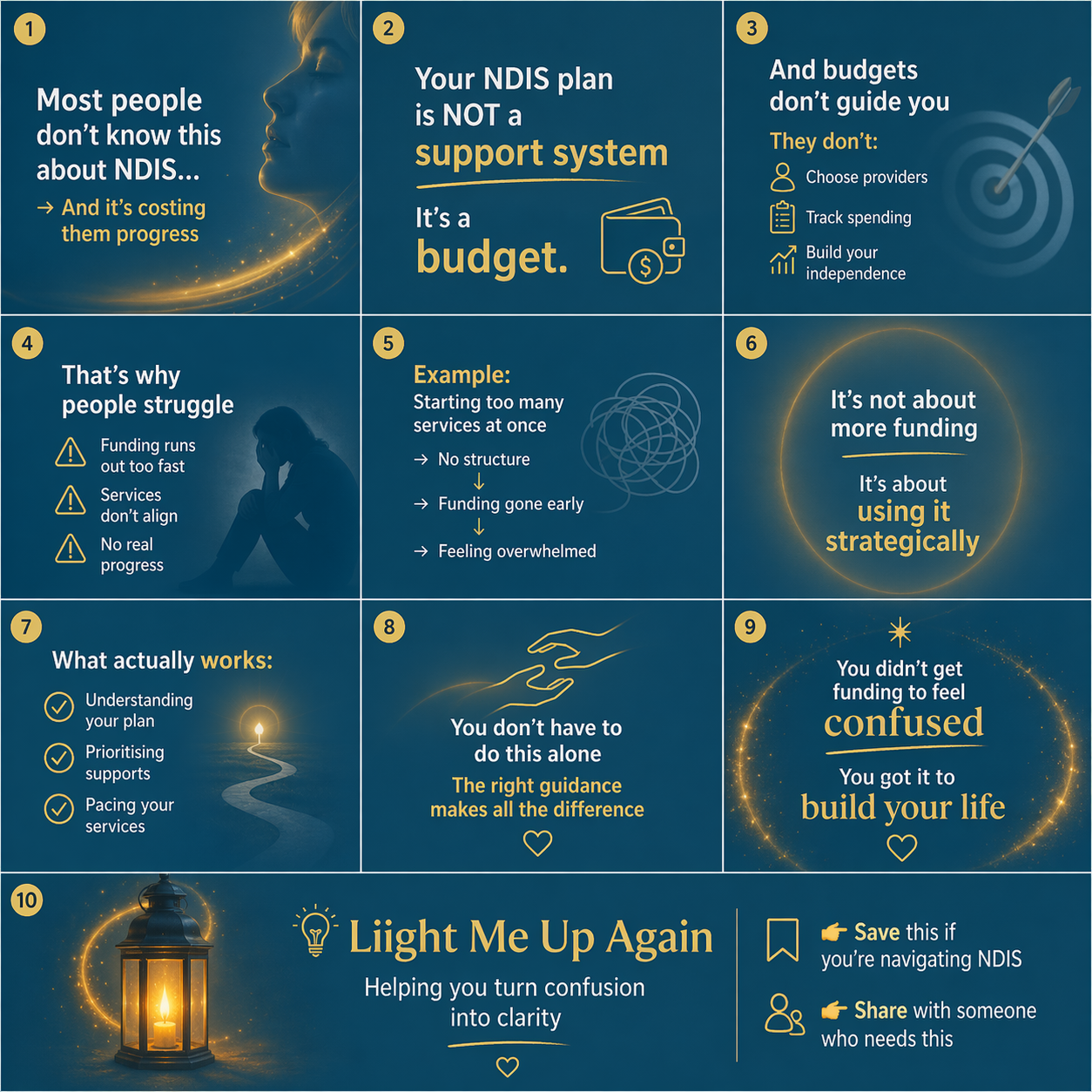
Many people believe that once they receive their NDIS plan, everything will automatically fall into place. But the truth is NDIS plan is not a complete support system. It’s a funding tool, and how you use it determines your outcome. If you don’t understand how the system works, you may end up feeling stuck, overwhelmed, or unsupported.
What most people don’t know about NDIS
A NDIS plan is essentially a budget allocated across different categories such as Core Supports and Capacity Building. However:
- It does not organise services for you
- It does not automatically connect you with providers
- It does not ensure your goals are achieved
Without proper guidance, many participants:
- Underutilise their funding
- Spend funds too quickly without long-term benefit
- Choose supports that don’t align with their goals
Why this happens
The NDIS system can be complex and confusing, especially for new participants.
There are:
- Multiple funding categories
- Different service providers
- Strict guidelines on how funds can be used
Without clear understanding, participants often make decisions based on urgency rather than strategy which can lead to burnout, frustration, or lack of progress.
When it becomes a problem
You might notice issues when:
- Your funding is running out faster than expected
- You’re not making progress toward your goals
- You feel overwhelmed managing services
- You’re unsure what supports you actually need
This is usually the point where participants realise their plan isn’t working effectively.
Example from real-life scenario
Let’s say a participant receives funding for therapy, support work, and capacity building.
At the beginning:
- They start multiple services at once
- Book frequent sessions without a clear plan
- Don’t track their spending
After a few months:
- Their Core funding is nearly exhausted
- They haven’t built independence
- They feel stressed and unsupported
Why? Because there was no structured approach to using the funding.
Now compare that with a guided approach:
- Prioritising essential supports first
- Spacing services strategically
- Aligning supports with long-term goals
The result?
Better outcomes, less stress, and more sustainable support.
How to make your NDIS plan work for you
To get the most out of your plan:
1. Understand your funding
Know what each category is for and how it can be used.
2. Be intentional with supports
Choose services that directly align with your goals.
3. Monitor your spending
Track your funding regularly to avoid early exhaustion.
4. Build a structured plan
Don’t rush into everything at once, pace your supports.
5. Seek the right guidance
Support Coordinators and Psychosocial Recovery Coaches can help you:
- Navigate the system
- Connect with the right providers
- Build long-term independence
Why support coordination matters
Many participants struggle not because of lack of funding, but because of lack of direction and coordination.
With the right support:
- Your plan becomes structured
- Your goals become achievable
- Your stress significantly reduces
The NDIS is not just about receiving funding it’s about using it effectively to improve your life. You don’t need more funding. You need a clear strategy. Once you understand how to use your plan properly, everything changes from confusion and overwhelm… to clarity, control, and real progress.
#liightmeupagain #liightmeupagainservices #Socialwork #supportcoordination #psychosocialrecoverycoaching #thrivewithzakia #personaldevelopmentcoaching #mindsetcoaching #careerdevelopmentcoaching #publicspeaking #leadershipcoaching #relationshipcoaching #resileincespeaker #recoveryspeaker #professionaldevelopmentcoaching #consultation #NDIS #NDISTips #NDISGuide #DisabilitySupport #NDISHelp #NDISFunding #NDISExplained #NDISCommunity #NDISServices #DisabilityAustralia #NDISPlanManagement #HowNDISWorks #NDISSupportCoordination #PsychosocialRecoveryCoach #NDISFundingTips #NDISParticipantGuide #HowToUseNDISFunding #NDISAustraliaSupport