

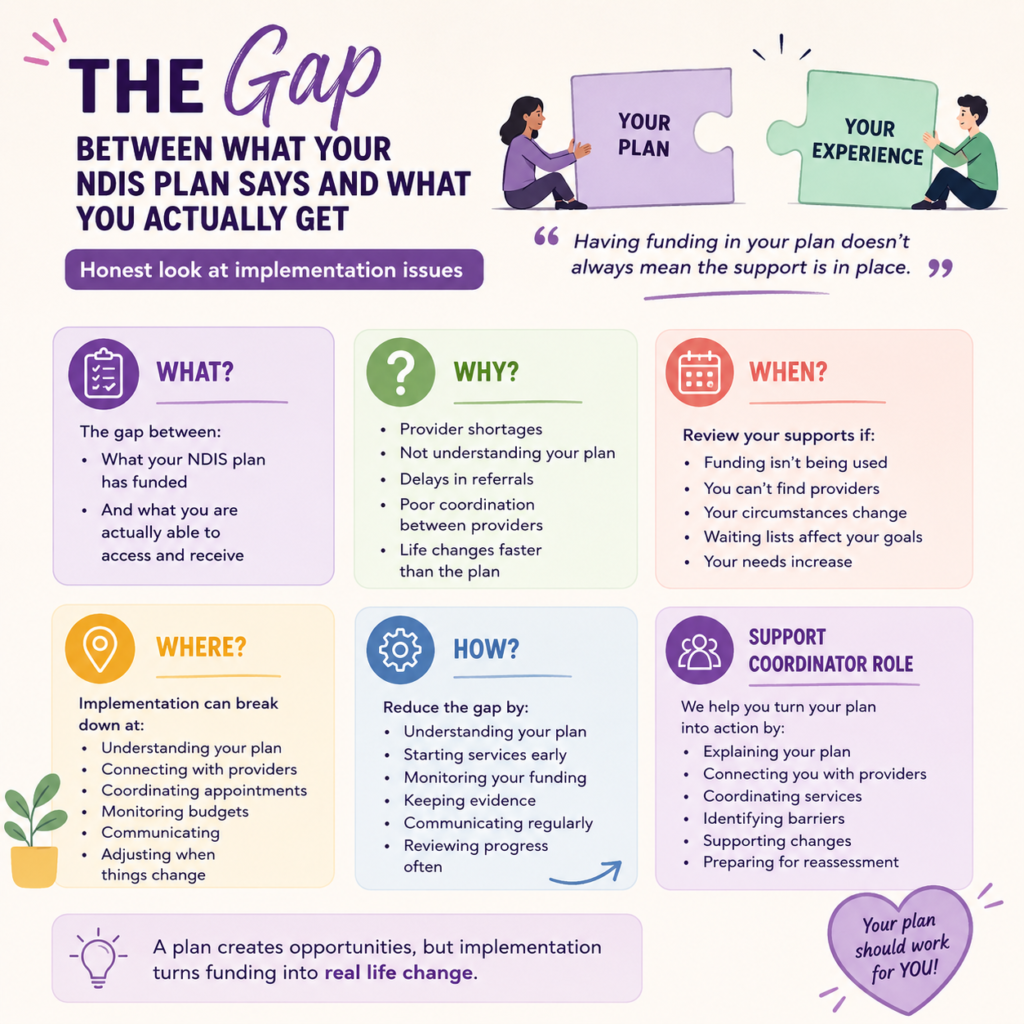
Having an approved NDIS plan is an important milestone but it’s only the beginning of the journey. For many participants and families, the biggest challenge isn’t getting funding approved. It’s turning that funding into meaningful, consistent supports.
Your plan looks great on paper… so why aren’t you receiving the supports?
Many participants receive an NDIS plan with funding for therapies, support workers, assistive technology, home modifications, or community participation. On paper, everything appears to be in place. Yet months later, many people are still waiting for services, struggling to find providers, or unsure how to use their funding. This disconnect is one of the biggest challenges within the NDIS.
What is the gap?
The gap is the difference between:
What your NDIS plan has funded
versus
What you are actually able to access and receive.
Having funding available does not automatically mean the support is available or easy to access.
Why does this gap happen?
There isn’t usually one single reason. Often, it’s a combination of factors.
1. Provider shortages
In some regions, there simply aren’t enough providers.
Participants may have funding for:
- Occupational Therapy
- Speech Pathology
- Psychology
- Physiotherapy
- Behaviour Support
…but waitlists can extend for months.
Without providers, funding remains unused.
2. Participants don’t fully understand their plan
Many participants receive a lengthy NDIS plan without anyone explaining:
- What each funding category means
- Which budgets are flexible or stated
- What supports they can access
- How to prioritise spending
Without this understanding, valuable funding may sit unused.
Delays in referrals
Sometimes referrals are not made promptly. A participant may have funding for therapy or assessments but no referral has been sent, delaying access to services.
4. Limited coordination between providers
Support works best when providers communicate with one another. When therapists, support workers, plan managers, families, and support coordinators work in isolation, opportunities can be missed and participants may receive fragmented support.
5. Life changes faster than the plan
A participant’s needs can change due to:
- Hospital admissions
- Health deterioration
- New diagnoses
- Changes in family support
- Housing changes
The plan may no longer reflect the participant’s current circumstances, making implementation more difficult.
When should you review your supports?
Don’t wait until the end of your plan.
Review your supports if:
- Funding is not being used.
- You cannot find providers.
- Your circumstances have changed.
- Waiting lists are affecting your goals.
- Your needs have increased.
- Your current supports are no longer suitable.
Regular reviews help identify issues early and allow time to explore solutions.
Where can implementation break down?
Challenges can arise at different stages:
- Understanding the NDIS plan
- Connecting with suitable providers
- Coordinating appointments
- Monitoring budgets
- Communicating between providers
- Adjusting supports when circumstances change
Recognising where the barriers exist is the first step towards addressing them.
How can you reduce the gap?
There are practical ways to improve implementation:
Understand your plan
Know what funding you have and what each budget is intended to support.
Start services early
Arrange providers soon after your plan begins rather than waiting until funding is running low or the plan is close to ending.
Monitor your funding
Regularly review your funding utilisation with your Plan Manager or through the my NDIS portal.
Keep evidence
Maintain reports, progress notes, assessments, and records of any changes in your circumstances.
Communicate regularly
Encourage communication between providers, your Support Coordinator, your family, and other key supports to ensure everyone is working towards the same goals.
Review progress
Ask yourself:
- Are my goals being achieved?
- Are my supports still appropriate?
- Do I need additional assessments or referrals?
The role of a Support Coordinator
A Support Coordinator doesn’t make funding decisions or provide therapy. Their role is to help participants put their NDIS plan into action.
This may include:
- Explaining the NDIS plan
- Connecting participants with suitable providers
- Coordinating services
- Monitoring implementation
- Identifying barriers to accessing supports
- Assisting with changes in circumstances
- Helping prepare for plan reassessments
When implementation is actively monitored, participants are more likely to access the supports that help them work towards their goals.
An approved NDIS plan creates opportunities, but its value depends on how effectively it is implemented. If there is a gap between what your plan says and the supports you are actually receiving, it’s worth exploring why. Identifying barriers early, maintaining good communication, and reviewing your supports regularly can help ensure your plan is working as intended. The goal isn’t simply to have funding in a plan, it’s to translate that funding into practical supports that improve everyday life.
#liightmeupagain #liightmeupagainservices #Socialwork #supportcoordination #psychosocialrecoverycoaching #thrivewithzakia #personaldevelopmentcoaching #mindsetcoaching #careerdevelopmentcoaching #publicspeaking #mentor #mentoringsupport #inhomesupport #communityengagement #ndisprovidersadelaide #leadershipcoaching #relationshipcoaching #resileincespeaker #recoveryspeaker #professionaldevelopmentcoaching #consultation #NDIS #NDISTips #NDISGuide #DisabilitySupport #NDISHelp #NDISFunding #NDISExplained #NDISCommunity #NDISServices #DisabilityAustralia