
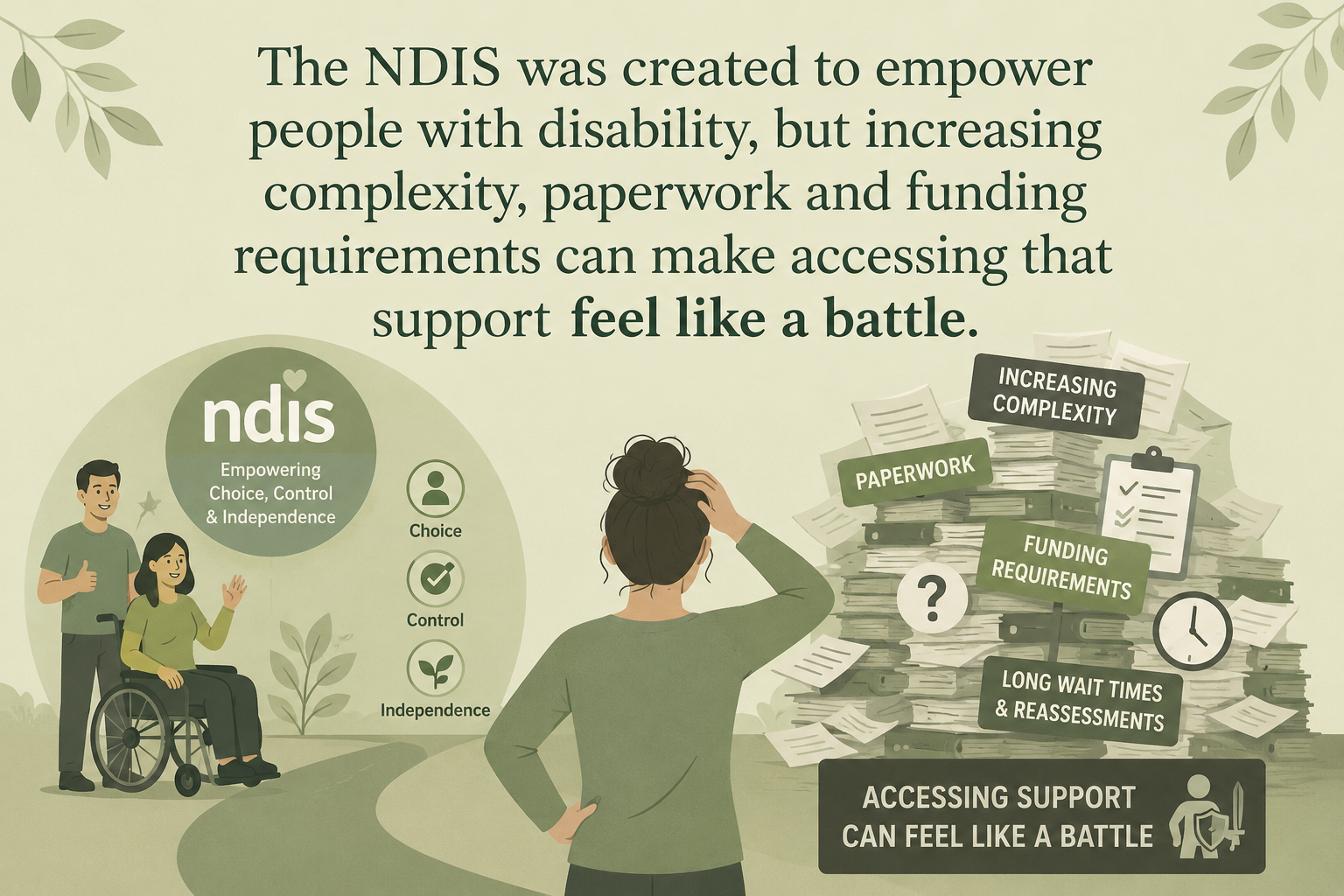
From a groundbreaking disability-rights reform to a system many participants now find difficult to navigate. I’ve sat across from people crying, not because of their disability, but because of the paperwork. Think about that for a moment. A system created to give Australians with disability greater choice, control, independence and access to support can sometimes feel like another obstacle they have to overcome.
Forms
Report.
Funding categories
Evidence
Plan reassessments
Phone calls
Emails
Waiting
And for some participants and families, the exhaustion of navigating the system becomes almost as overwhelming as managing the disability itself. But to understand why the NDIS feels so complicated today, we need to understand why it was created in the first place.
Before the NDIS: Why was there a need for reform?
The NDIS didn’t appear out of nowhere. Before the scheme, disability services in Australia were largely delivered through a mixture of state and territory programs, community organisations and other support systems. Access to services could depend heavily on where someone lived, what services existed locally, the nature of their disability and whether funding was available.
The Productivity Commission’s 2011 inquiry described the existing disability support system as underfunded, unfair, fragmented and inefficient, with people experiencing limited choice and uncertainty about accessing appropriate support. That is an important part of the NDIS story.
Because when we criticise the complexity of today’s NDIS, we shouldn’t forget why Australians demanded change in the first place. People with disability and their families had spent years advocating for a system that was more equitable and person-centred.
Grassroots advocacy, including the Every Australian Counts campaign, helped build public support for a national disability insurance scheme.
The fundamental idea was powerful:
Disability support should not depend simply on where you live.
2011: The Turning point
In 2010, the Australian Government asked the Productivity Commission to investigate the possibility of creating a long-term national disability care and support scheme.
The Productivity Commission delivered its report in 2011.
Its recommendation was transformative: Australia should establish a National Disability Insurance Scheme. The proposed scheme was based on the idea that Australians with significant disability should have access to long-term, high-quality disability supports, with government sharing the financial risk of significant disability, similar in principle to how insurance systems pool risk. All governments agreed to establish the NDIS following the release of the Productivity Commission’s report. This wasn’t simply a new funding program. It was intended to be a fundamental redesign of disability support in Australia.
2013: The NDIS becomes reality
The NDIS Act was passed in 2013. On 1 July 2013, the first NDIS trial sites commenced.
The trial began in four locations:
- Hunter, NSW
- Barwon, Victoria
- Tasmania
- South Australia
The purpose of the trial wasn’t simply to start paying people.
It was also an opportunity to test whether a national individualised disability-support model could work at scale.
The scheme was built around a very different philosophy.
Instead of simply asking: “What disability services are available?”
the NDIS asked: “What reasonable and necessary supports does this individual need to pursue their goals and participate in everyday life?”
That was a major shift.
From a service-based system to an individualised system
This change is incredibly important. Imagine two people with the same diagnosis. One may live independently. The other may need substantial assistance with communication, personal care, community participation and daily living. A diagnosis alone doesn’t tell us everything about a person’s support needs. The NDIS therefore placed much greater emphasis on individual circumstances and functional impact. This created opportunities for people to exercise greater choice over their providers and supports. And for many participants, this has been life-changing.
The NDIS expanded, quickly
The trial period demonstrated that the scheme could operate across different locations, and the NDIS progressively expanded. By 2021, the NDIS reported supporting more than 450,000 Australians with disability, including many people who had not previously received disability supports. That growth is remarkable. But it also created a new challenge:
How do you run a highly individualised national scheme for hundreds of thousands of people while maintaining quality, consistency and financial sustainability?
And this is where today’s story becomes complicated.
The bigger the NDIS became, the more complex it became
The original vision was centred around the individual.
But a national system supporting hundreds of thousands of people requires:
- legislation,
- regulations,
- funding rules,
- pricing arrangements,
- eligibility processes,
- evidence requirements,
- provider regulation,
- financial controls,
- quality and safeguarding systems,
- planning processes,
- reviews,
- reassessments,
- and accountability.
The larger the system becomes, the more infrastructure it requires. And that infrastructure can feel very different from the simple idea that originally inspired the scheme. For a participant, it can become: “I just need support.”
But the system may respond: “Please provide evidence.”
The participant says: “I need therapy.”
The system asks: “What is the functional impact? What is the clinical rationale? Is it disability-related? Is it reasonable and necessary? Is there evidence? Is another system responsible?”
All of those questions can have legitimate purposes. But collectively, they can become overwhelming.
So, when did support become paperwork?
This is where we need to be fair. The NDIS cannot operate without accountability. It is a publicly funded scheme. There must be safeguards against fraud, inappropriate spending and poor-quality services. There must also be a way to determine whether a support is genuinely related to a person’s disability and whether it represents value for money. The Productivity Commission itself recognised the need for proper governance, safeguards and sustainable funding when it proposed the original scheme. The problem isn’t necessarily accountability. The problem is when accountability becomes so complicated that the person at the centre of the system gets lost.
The sustainability question
As the NDIS grew, so did expenditure. The Productivity Commission has subsequently examined the rising costs of the scheme and issues including cost pressures, sustainability and the effectiveness of different approaches to managing expenditure. This created a difficult policy dilemma. Australia wants an NDIS that provides appropriate support to people with significant disability. But Australia also needs a scheme that can remain financially sustainable over the long term. These two goals should not be treated as enemies.
Sustainability protects the future of the NDIS.
But sustainability should not mean that participants experience unnecessary barriers to appropriate support.
And this is where participants feel the pressure
For a participant, the policy debate about sustainability can become very personal.
It can mean:
“Will my therapy continue?”
“Will my support worker hours be enough?”
“Will my assistive technology be approved?”
“What happens when my plan ends?”
“Why do I need another assessment?”
“Why do I have to explain my disability again?”
For families, it can mean spending evenings reading reports and trying to understand funding categories.
For Support Coordinators, it can mean spending hours:
- contacting providers,
- monitoring budgets,
- requesting reports,
- following up referrals,
- communicating with the NDIA,
- preparing for reassessments,
- and helping participants understand what their plans actually mean.
And for allied health professionals, it can mean writing increasingly detailed evidence to explain something that may already be obvious in a person’s daily life.
The gap between policy and real life
This, to me, is one of the biggest challenges facing the NDIS. Policy is written on paper. Disability is experienced in real life. A policy document may talk about funding categories. A participant may be sitting at home wondering how they’re going to shower safely.
A policy may talk about functional capacity. A family may be trying to prevent another crisis. A policy may talk about evidence. A person may simply be saying: “I need help.”
Both perspectives matter. We need rules. But we also need humanity.
Why support coordination has become so important
As the NDIS has become more complex, Support Coordination has increasingly become a bridge between the participant and the system.
A good Support Coordinator isn’t simply someone who makes referrals.
They may help a participant:
- understand their NDIS plan,
- connect with appropriate providers,
- coordinate multiple services,
- monitor funding,
- understand how different supports interact,
- prepare for reassessments,
- communicate with providers,
- navigate problems,
- and advocate for their needs.
But there is an important warning here. Support Coordinators should not become another layer of bureaucracy. The ultimate goal should always be to help participants become more confident, informed and connected, not dependent on professionals to interpret every part of their lives.
What about the future?
The NDIS is now at another important point in its history.
The challenge isn’t simply whether the NDIS should exist.
The bigger question is:
How do we preserve what worked while fixing what doesn’t?
The Productivity Commission has recently reflected on this same tension, noting that the NDIS has transformed the lives of hundreds of thousands of Australians while also arguing that reform is needed to preserve its core purpose and financial sustainability.
That is the conversation we should be having.
Not: NDIS good vs NDIS bad.
But: What should the NDIS become next?
We need to remember why it was created
The NDIS was born because the previous disability support system was not working well enough. It was created because people with disability deserved:
Choice
Control
Dignity
Independence
Inclusion
Those principles haven’t become outdated. If anything, they are more important than ever. But achieving those principles requires more than funding. It requires a system that people can actually understand and navigate.
The NDIS should not become a test of administrative endurance
A person shouldn’t need to become an expert in NDIS legislation to understand their own plan. A parent shouldn’t need to become a professional report writer to explain why their child needs support. A person with psychosocial disability shouldn’t have to repeatedly retell painful experiences simply to prove that their needs are real. And a Support Coordinator shouldn’t spend so much time fighting paperwork that there is little time left for the person sitting in front of them.
Accountability matters.
Sustainability matters.
Evidence matters.
But so does humanity.
The NDIS is worth improving
I don’t believe that questioning the NDIS means opposing the NDIS. Quite the opposite. If we believe in the original vision, we should care enough to ask difficult questions. How can we reduce unnecessary administration? How can we make communication clearer? How can we make evidence requirements proportionate? How can we protect public funding while ensuring people receive the support they genuinely need? How can we listen more effectively to people with lived experience? How can we make the system easier to navigate without removing necessary safeguards? These aren’t anti-NDIS questions. They are pro-participant questions.
The real measure of success
Ultimately, the success of the NDIS shouldn’t only be measured by:
- how much money is allocated,
- how many plans are created,
- how many providers are registered,
- or how many reports are processed.
We should also ask:
Are people more independent?
Are people participating in their communities?
Are families less overwhelmed?
Are people achieving their goals?
Are people living with greater dignity and choice?
Because behind every plan is a human being.
Behind every funding request is a need.
Behind every report is a person’s life.
And behind every NDIS reform should be the same question that started this entire journey:
Are we making life better for people with disability?
The NDIS was built to help people.
Let’s make sure the system never loses sight of the people it was built for.
What has your NDIS experience been?
Have you ever felt that you were spending more time proving you needed support than actually receiving it?
Have you found the NDIS empowering or overwhelming?
Have you supported someone through the system?
Share your experience in the comments.
Because meaningful reform doesn’t begin with another form.
It begins with listening.
NDIS Australia, NDIS history, National Disability Insurance Scheme, NDIS reform, NDIS funding, NDIS Support Coordination, NDIS participants, NDIS plan reassessment, NDIS challenges, disability support Australia, disability advocacy, NDIS providers, NDIS funding changes, disability services Australia, NDIS sustainability, NDIS participant experience
#liightmeupagain #liightmeupagainservices #Socialwork #supportcoordination #psychosocialrecoverycoaching #NDIS #NDISTips #NDISGuide #DisabilitySupport #NDISHelp #NDISFunding #NDISExplained #NDISCommunity #NDISServices #DisabilityAustralia #inhomesupport #consultation #communityengagement #mentor #mentoringsupport #ndisprovidersadelaide #personaldevelopmentcoaching #mindsetcoaching #careerdevelopmentcoaching #publicspeaking #leadershipcoaching #relationshipcoaching #resileincespeaker #recoveryspeaker #professionaldevelopmentcoaching